
Hi everyone,
Fall is in full swing in New England, and Koda and I are making the most of the crisp, clear days.

I've been reading about Churchill in 1940. Around Dunkirk, he never played down how grave things were, but he kept projecting confidence that there was a path through. That felt like the right posture for security and IT teams this week, which was a real doozy. The big news wasn't AI agents breaking loose. It was real flaws in everyday code that most companies run, found with AI's help, with attackers already trying them before many teams had patched. That's where this issue starts.
Cheers.
Reza
⏱️ The Brief
AI helped researchers find two critical flaws in PHP, the programming language behind WordPress and many other websites, and Amazon says it caught an attempt to exploit them four days before the fixes came out on October 21. Ask your IT lead and whoever runs your website whether you're patched, and whether your patch deadlines are still measured in days when Amazon now advises hours for critical flaws in internet-facing systems.
A tampered update of LiteLLM, popular software that connects company applications to AI models, stole AI keys and cloud logins from machines that installed it on October 21, LiteLLM says. Ask your engineering lead whether you installed that version, 1.107.0, and if so, whether every key it could reach has been replaced; then make sure every AI key you hold has a spending cap.
In a Boston Consulting Group (BCG) survey, 91% of sales leaders expect higher quotas or productivity targets in 2027, but only 13% name win rates as a top area where AI has helped so far. Before you approve next year's sales plan, ask your sales leader how much of the increase depends on AI, and which number will show by mid-year whether it's working.
Big US banks are finding AI agents inside customer accounts that the banks never approved, Axios reports. Separately, Wells Fargo's new terms, effective November 24, make customers responsible for whatever their AI agents do in their accounts, unless law or regulation says otherwise. Ask your finance lead which bank accounts any AI agent your team uses can reach, and whether it should.
Attackers got to AI-found flaws before the fixes, and some organizations switched services off

Illustration created with AI.
On October 21 the people who maintain PHP, the programming language behind WordPress and a large share of the world's websites, released fixes for two critical flaws. Under the right conditions, either flaw can let an attacker take control of a website's server without logging in. According to Wiz, a security firm owned by Google's parent Alphabet, every PHP version released in the last decade is affected.
AI helped find the flaws, and attackers moved faster
Wiz found the first flaw in August with help from AI models made by Google and OpenAI, and a second security firm, Calif, also worked on the flaws using OpenAI's models. "A single researcher completed in a week what previously would have taken a world-class team months of work," Wiz wrote. PHP's maintainers then prepared the fixes under an embargo, an agreement to keep the details private until a set release date, which was October 22.
The embargo didn't hold. The PHP Foundation says details leaked on October 20 through forum posts, a demonstration video published by mistake, and patched software released early by another company, so the fixes went out a day ahead of schedule. At least one attacker was ahead of everyone. Amazon says its decoy servers, which exist to attract attackers, caught an attempt to exploit the flaws on October 17, four days before the public announcement, and that more exploits appeared within hours of the details coming out. Amazon doesn't say how that attacker learned of the flaws, or whether AI was involved.
Amazon's broader point is about what happens once a fix is public: "AI-assisted analysis makes it cheaper to turn a patch diff or advisory into a working exploit." A patch diff is the published change to the code, so a fix shows exactly what was broken. In Amazon's account, AI now helps attackers turn that clue into a working attack quickly. Many companies give their IT teams a deadline for fixing security flaws, such as 7 or 30 days depending on how serious the flaw is, and some write similar deadlines into contracts with the vendors who run their systems. Security teams call these deadlines SLAs, short for service-level agreements. Amazon's advice for critical flaws in internet-facing systems is to "measure patch and mitigation timelines in hours," because "a 7-day or 30-day SLA assumes a delay that no longer exists," it wrote.
Some organizations switched services off
Some organizations took systems offline as a precaution while they patched. The UK government took 32 services offline, with no confirmed compromise, the Financial Times reported. The Wikimedia Foundation, which runs Wikipedia, Finland's state IT centre, Germany's federal IT provider, and the Dutch National Cyber Security Centre also took systems offline, according to Reuters. PHP versions 8.1 and older get no official new release, only code changes that most hosting customers can't apply themselves. A scan by the security firm CybelAngel found that more than half of the internet-facing servers that report their PHP version run one of those older versions. The US Cybersecurity and Infrastructure Security Agency (CISA) told organizations that can't update to "take PHP-based systems offline until they can be patched or updated." CISA's alert, last updated October 23, says it hadn't seen a successful attack when the alert was published, and we found no confirmed breach reported as of October 24, though attempts have been widespread. At a mid-sized company, the PHP in question is often the marketing website or a WordPress-based customer portal, frequently looked after by an outside agency or hosting company.
The AI tools inside your systems are targets too
The same week, attackers also went after the AI software companies run inside their own systems. On October 21 attackers slipped a tampered version of LiteLLM into its normal download channel. LiteLLM is popular open-source software that companies run as a gateway between their applications and many AI models, which means it holds the keys to all of them. For about two hours, anyone who installed the update from its main download channels, including its Docker image, got software that stole cloud logins and AI provider keys, according to LiteLLM and the monitoring company Datadog. Railway, a hosting service for developers' applications, disclosed a breach the same day and said in an October 22 preliminary report that the attacker appeared to be after customers' keys to AI services. And in an October 20 report, Wiz described attackers who take over companies' cloud accounts to run AI at the victims' expense, with "unexpected charges" reaching "tens to hundreds of thousands of dollars" within 24 to 48 hours of the break-in. No one has linked these incidents to each other.
My read: AI helped find these flaws, and once a fix is public it also shrinks the time teams have to respond, as Amazon argues. That put everyone behind the eight ball this week, with some organizations taking services down while they patched. The LiteLLM incident is a separate problem with a related lesson. AI tools inside a company's systems often hold valuable credentials, and a gateway like LiteLLM holds the keys to every AI provider a company uses. That's why the security and control review before an AI service goes into the stack matters more now, and why such tools need the same scrutiny as any system that holds passwords.
💬 Overheard in IT: the PHP servers nobody knew about

Illustration created with AI.
I saw this post trending on X the day the PHP fixes came out. I can't vouch for its authenticity (it's from a humor account that posts IT war stories), but the story will resonate with anyone who has lived through a week like this one. It opens with a 6:12 am call from security, and it only gets better.
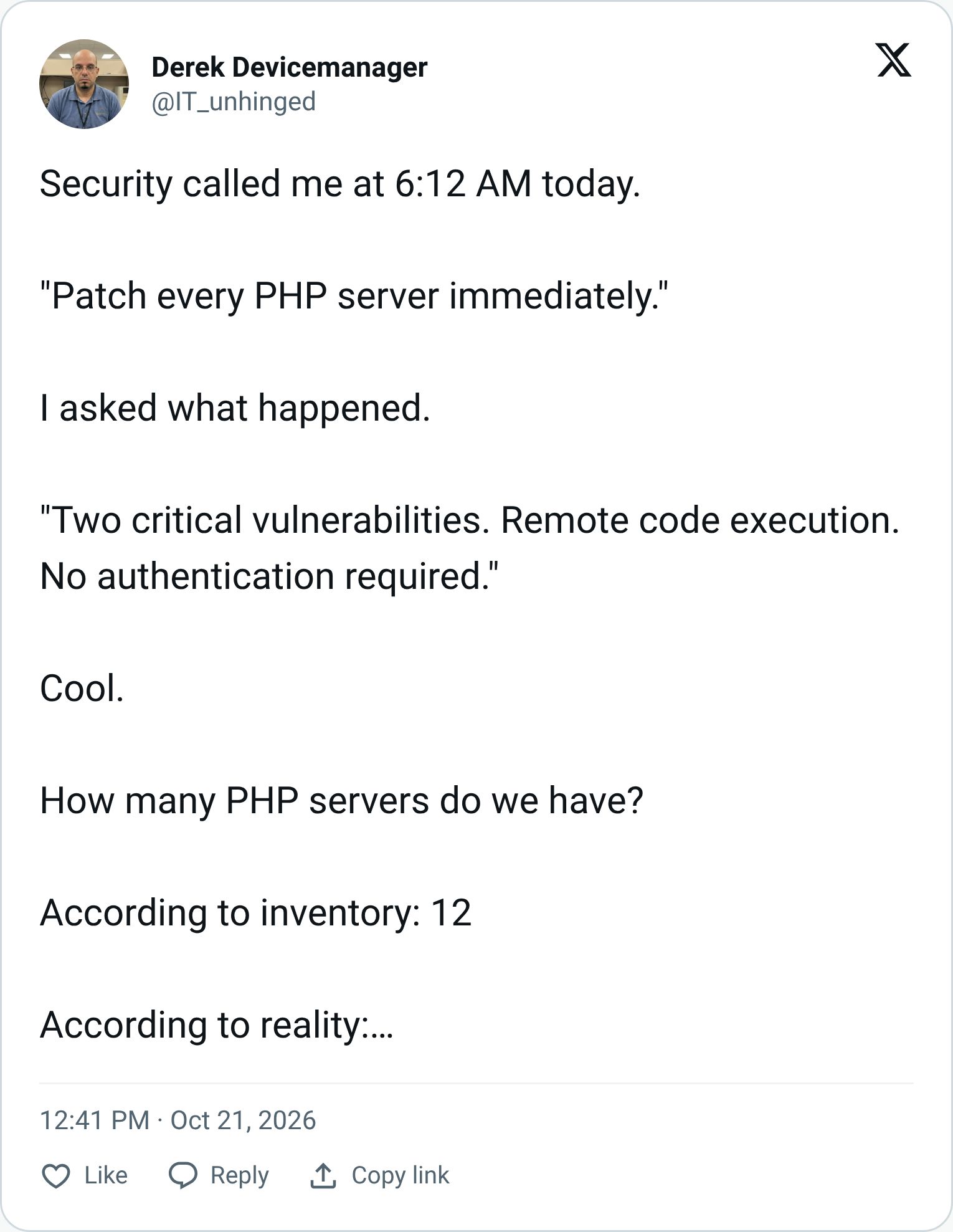
Post on X by Derek Devicemanager (@IT_unhinged), October 21. Read the full post on X.
Sales plans for 2027 lean on AI gains that few sales leaders yet see in win rates
Sales leaders are planning for bigger 2027 targets, and Boston Consulting Group (BCG) says those plans assume a productivity gain from AI that hasn't arrived yet. BCG surveyed 398 sales leaders at large companies in 23 countries for a report published on October 19. They include chief revenue officers, the executives who own a company's revenue number, and the revenue operations leads who run the sales process. 91% expect per-seller quotas or productivity requirements to rise next year, 72% expect bigger sales budgets, and 65% expect sales headcount to grow.
Almost every one of these teams uses AI: 90% report meaningful AI use in sales work, though only 6% have AI running whole sales processes on its own. Asked to name the top areas where AI has made a measurable difference, they mostly name work behind the scenes. A third cite less administrative work and 18% better sales forecasts. Only 14% name better conversion of prospects into customers, 13% better win rates, and 8% more sellers hitting quota. "Those plans assume a productivity step-change that AI has not yet delivered," Federico Fabbri, a BCG senior partner, said in the press release.
BCG's explanation is that most of the AI is aimed at the wrong part of the sale. Nearly 60% of respondents say buyers now arrive better informed, and 51% say buyers expect proof of value built for their business, such as an ROI case, before they sign. Asked separately where their AI spending has paid off so far, respondents point mostly to seller productivity and reaching more accounts (51%) and to sorting out which prospects are worth pursuing (44%); only 32% point to that proof-of-value work.
BCG calls a minority of respondents AI-advanced, defined only as companies with more AI agents (software that carries out tasks on its own) in use. They report improved conversion twice as often as the rest (23% versus 11%) and double-digit revenue growth more often (69% versus 42%). They also measure more: 67% of them have formal AI adoption targets, against 23% of the rest. These are correlations from a self-reported survey by a firm that sells sales transformation, and faster-growing companies may simply be able to afford more AI. BCG doesn't say when the survey ran or where the line for "advanced" sits.
For anyone approving a 2027 sales plan, a quota increase that leans on AI productivity rests on something few sales leaders report yet: AI helping their teams close more deals.
💬 Overheard on X: security's moment

"Cybersecurity startups trying to raise funding right now," over a plush toy dancing under rave lasers. A meme, not market data, about security founders after a week like this one. Posted on X by Aman (@Amank1412) on October 22, via the Superhuman AI newsletter.
📶 News Bits
Big US banks are finding unvetted AI agents inside customer accounts, mostly logged in with the customer's own password, Axios reported on October 22; Morgan Stanley, Bank of America, JPMorgan and Wells Fargo are among those racing to contain the risk. People at the banks told Axios they often can't tell whether an agent is following the customer's instructions or acting on its own. Wells Fargo's answer, in terms that take effect November 24, is to treat whatever an agent does in an account as authorized by the customer, unless law or regulation provides otherwise.
Anthropic is asking law firms how AI agents should negotiate for the people they represent, the Financial Times reported on October 18, citing two people familiar with its thinking. The questions include how often an agent should check back with the person it represents and how suspicious it should be of the agent across the table; Anthropic declined to comment. My read: we're still borrowing human norms for agent-to-agent deals, and if agents deal directly with agents, there may be less work for lawyers.
Muse, Meta's AI assistant app that can act on its own initiative instead of waiting to be asked, passed 10 million downloads in about a month, The Economist reported, citing the app-data firm Sensor Tower. In the same week, Meta paused Muse's sharing feature after a security firm found more than 6,800 links to conversations users had shared in public internet records, and some of the pages it opened held business documents, Ars Technica reported on October 20.
Anthropic's Claude Code team, whose code is now about 90% written by Claude, says it more than doubled the code changes it merged between June and September while the share it had to undo fell by more than 40%. In a blog post, the team describes AI reviewers doing most of the reading, with the number of people who must approve set by each change's risk. These are Anthropic's own figures.
The US AI infrastructure boom, projected at more than $10 trillion from 2025 to 2032, is running into delays and nervous investors, the Financial Times reports. At least 47 large projects were delayed, withdrawn or blocked this year, according to the research firm RegLayer, and the brokerage Bernstein judges only about 35% of the planned pipeline credible.
OpenAI released more than 700 papers on October 6 claiming progress on 372 long-unsolved maths problems, and The Economist argued that science now needs to reward people for checking what AI produces. AI is also making bad science easier to publish: an analysis of 2.5 million biomedical papers found the rate of fabricated citations rose 12-fold between 2023 and early 2026, probably because of growing AI use, The Economist reported separately.
🧾 The AI Bill
New this week, and an experiment for the next few issues: quick items on what moved in AI prices and costs, for whoever owns the AI budget.
OpenAI now lets developers store the repeated opening of a prompt for at least 12 hours, which can cut the cost of that repeated opening by about 70% when it's reused hourly. Since October 20, developers who build on newer OpenAI models (GPT-5.6 and later, through its Responses API) can cache the repeated opening of a prompt for at least 12 hours instead of the default 30 minutes. That opening is text sent with every request, such as standing instructions, and must be at least 1,024 tokens, the chunks of text AI services bill by. Under OpenAI's published rates, saving it to the 12-hour cache costs 2.5 times the normal input price, and each later use costs a tenth of the normal price on most of those models. By our arithmetic, 12 uses in 12 hours (one save plus 11 reuses) cost 3.6 times the normal price for that repeated opening, instead of 12 times without caching, about 70% less. New input in each request and the model's output are billed as usual. A prompt used only twice a day costs more with this option.
An Anthropic staff member estimated that running its Claude Fable model at the maximum effort setting costs about six times as much per question as medium effort. Mark Dominguez of Anthropic's customer success team gave the figure as a spoken estimate in an October 7 webinar on controlling Claude Enterprise costs; it isn't in Anthropic's published pricing. The price per token, the chunk of text AI services bill by, doesn't change. Higher effort makes the model think longer, and Anthropic bills that thinking as output, so the same question uses more tokens.
🌍 Meanwhile...
Plenty of room at the bottom

Chart: Quanta, drawn from the article's estimates.
In 1959, the physicist Richard Feynman told a room of scientists that nothing in physics stopped us from writing an entire encyclopedia on the head of a pin. For decades, the computer industry lived off that idea, making chips smaller and smaller so each new generation got faster and cheaper. That trick is running out, so today we mostly get more computing power by building more and bigger data centers.
Volkan Gurses, an MIT researcher, asks a different question in MIT Technology Review: how much better could computers get before they hit walls set by physics itself? Think of four walls (energy, moving data, memory and speed). Today's chips aren't close to any of them.
That gap is where the opportunities are for making computing far better. Moving data quickly, as fast as physically possible, is the wall the industry will likely hit first, and Nvidia and Broadcom already ship connections that carry data as light, built right next to the chip. On energy, a startup called Vaire Computing tested a chip in 2025 that recycles some of its own energy instead of losing it as heat. As for storage, one promising technique is storing data in DNA, which could pack far more information into far less space, though it's still far off.
None of this is a roadmap, and Gurses admits some of these ideas have been "perpetually 10 years away for 40 years." But the transistor and the laser were lab experiments once, too.
📚 What I'm Consuming
How employment is changing at Anthropic · Research report, Anthropic. A great discussion of work shifting from people to AI agents, drawn from Anthropic's data on its own staff.
How to be more ambitious: A tutorial for humans with models · Blog post, Felix Rieseberg of Anthropic. Excellent advice on prompting frontier AI models.
Did Claude Duet just kill Grok Bot? · Video, Alex Finn. A good overview of Claude Duet, Anthropic's new AI assistant for small-business back-office work, now in preview.
The $15bn 'viral' AI start-up changing how American doctors treat patients · Financial Times. How OpenEvidence, a free, ad-funded chatbot for clinical questions, spread to what it says is nearly two-thirds of US doctors.
We Built an AI CFO to Help You Grow Your Net Worth · Video, Peter Yang with Anthony Pompliano. How a team of fewer than 10 built Silvia, an AI financial adviser for individual investors.
Andrej Karpathy on reading AI output · Post on X. Four ways to have a model present its answers, from plain technical English to diagrams, web pages and explainer videos.
🌙 After Hours
Backrooms
Dir. Kane Parsons | 2026 | 111 min | ★★★★★ | Chiwetel Ejiofor, Renate Reinsve, Mark Duplass

Kane Parsons turned his YouTube web series into the indie studio A24's biggest hit. Clark (Chiwetel Ejiofor), whose furniture store, marriage, and sobriety are all failing, finds a doorway in his store's basement into the Backrooms, an endless maze of empty, office-like rooms that copy the real world badly. It isn't horror in the traditional sense. It plays as a mystery, and it reminded me of Jacob's Ladder: a reality where parts don't make sense and leaves a lot to your interpretation.
The fascinating part of the movie, without giving it away, is its exploration of human memory and the internal struggles we face dealing with conflict and personal choices. The movie was intellectually stimulating, making you think about how the human mind and our experiences work. The performances are excellent, the confining, fluorescent feel is perfect, and the pace is right. Parsons won't explain the ending, so plenty stays open. Good dinner conversation with friends who have already seen it!
🎙️ Listen
Prefer to listen? Quanta Bits is also available on Apple Podcasts and Spotify.
How this gets made
I collaborate with Spock, my AI agent. He researches extensively: scanning, filtering, and surfacing what's relevant across my business. I read, listen, and watch what resonates, and decide what matters. I provide direction, we draft together. The editorial judgment is mine. He'd tell you the same. Most logical. 🖖
